On 20 January 2025, the U.S. administration issued an Executive Order freezing all foreign assistance funds for 90 days, including funds distributed by the US President’s Emergency Fund for AIDS Relief (PEPFAR). The following months saw sweeping cuts, reversals, and mass firings (USAID’s staff were cut from 10,000 personnel to 15), and a series of lawsuits and appeals (see KFF’s helpful timeline for more on this). Researchers and advocates began immediately to document the impact and forecast future scenarios. This narrative review summarizes reports and analysis that I could find to date (August 2025).
In Ghana, Kenya and Vietnam, we found many young adults used web platforms (such as Google), social media platforms (such as Facebook, Instagram, TikTok, Twitter and YouTube), and social chat (such as WhatsApp, Zalo) to get health information, advice and peer support on sexual and reproductive health, HIV and Covid-19. The platforms brought clear benefits to young people, but also risks of censorship, abuse, stalking and other harms. These issues were largely not addressed by national laws and policies, and by global digital health policies such as the World Health Organization (WHO)’s Global Strategy on Digital Health 2020-2025.
The research was conducted using mixed qualitative methods and a transnational participatory action research approach in which communities of people living with HIV, as well as national civil society groups and human rights lawyers in Ghana, Kenya and Vietnam, participated in design of the study, data-gathering, analysis, and validation of the final results and recommendations. Our policy recommendations are outlined in a policy brief in English and Spanish.
We raised these concerns in an open letter to the director-general of WHO, Dr. Tedros, calling on WHO and other global health agencies to take action to protect young people from risks of harm when they seek health information online.
The study in Ghana, Kenya and Vietnam concludes the first phase of a multi-country study. The study continues in Bangladesh and Colombia, conducted in collaboration with social scientists at BRAC University and Universidad de los Andes, as well as civil society groups in both countries. The two universities also published their working paper based on desk review of laws and policies governing digital health in both countries, Digital Health and Rights in Bangladesh and Colombia.
We discussed the findings with researchers, social media influencers, health NGOs and an expert on sexual and reproductive health from WHO in a webinar, and the slides are below:
Three events to share: two recorded online, one up ahead, on my new book, The Uncounted: Politics of Data in Global Health — including an upcoming webinar featuring some activists profiled in the book.
For this episode, I reached out to two good friends who are wonderful data nerds and activists, Shirin Heidari and Marina Smelyanskaya, to talk about gender, inequality and data. When I invited Malu Marin, a longtime activist for the rights of migrant workers in Asia, she urged me to talk to her friend Jolovan Wham instead – “a very committed activist working directly with migrant workers”. Jolovan has come under more than his fair share of pressure for his advocacy for free speech – so especially grateful to him for his time, and to all three of this episode’s experts. Continue reading →
How are inequality and discrimination shaping data about COVID-19, and who is being left invisible and uncounted? On the launch of her new book on data and human rights, Sara (Meg) Davis speaks to social worker and rights activist Jolovan Wham in Singapore, who describes how thousands of migrant workers are being detained in overcrowded dorms, and were missed by the official mobile contact tracing app. In Geneva, Dr. Shirin Heidari (GENDRO) and Marina Smelyanskaya (Stop TB Partnership) address the global need for feminist principles and respect for human rights to gather data on COVID-19. Davis’ new book, The Uncounted: Politics of Data in Global Healthis available from Cambridge University Press.
Tina Alai (Kenyan human rights lawyer), Karyn Kaplan (Asia Catalyst), Margaret Mbira Omondi (Women Concerns Center, Kenya) and Prem Pramoj Na Ayutthaya (Rainbow Sky Association, Thailand) meet online to compare notes on how COVID-19 is fueling violence against women, from girls in evacuation camps in rural Kisumu, Kenya, to transgender women isolated in lockdown in urban Bangkok, Thailand. They found some surprising commonalities. Community-based activists and human rights advocates like themselves are putting marginalized communities at the center of their work, and finding ways to work together, using international human rights standards, to find a way out of this crisis.
With restrictions in many countries on nongovernmental organizations, and sweeping new laws coming into play in response to COVID-19, is space closing for civil society, journalists and other whistleblowers in global health? Leading international activists and journalists debated this question from national and international perspectives, on 19 May 2020, as part of the Graduate Institute’s 73rd World Health Assembly week. Co-organised by the Global Health Centre, STOPAIDS and Medicus Mundi International.
SPEAKERS
Gargeya Telakapalli, Research Associate, People’s Health Movement
Mercy Korir, Medical Doctor; Journalist, KTN News, Kenya
Mike Podmore, Executive Director, STOPAIDS; Chair, Action for Global Health
Nadejda Dermendjieva, Executive Director, Bulgarian Fund for Women
Thomas Schwarz, Executive Secretary, Medicus Mundi International
Moderated by Meg Davis, Special Advisor, Strategy and Partnerships, Global Health Centre
Episode 2 of the Right On Podcast: Human Rights Activists Respond to COVID-19 explores criminalization and policing. Many countries are now seeing the most significant deployment of law enforcement and national defense forces since World War II. Should they be arresting people who refuse to follow lockdown regulations? Or will aggressive policing, abuse and criminalization only undermine trust and fuel the virus? Should we also be considering the labor rights of frontline police officers? Can human rights offer us a way forward out of this crisis?
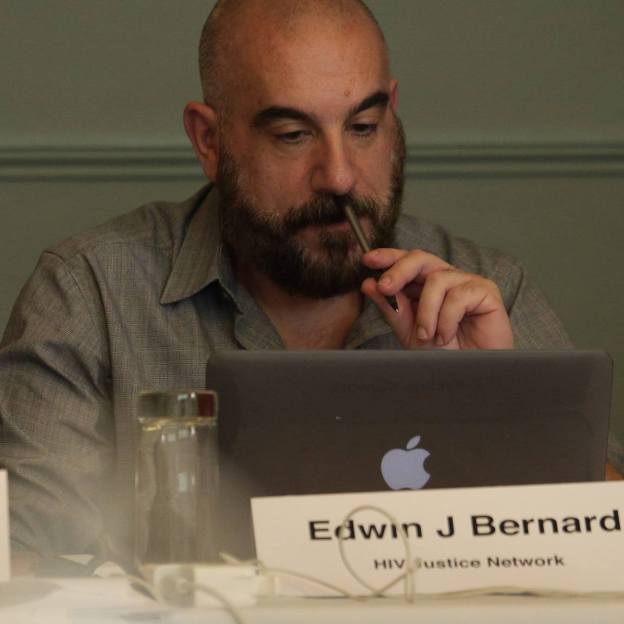
No easy answers, but it was a real delight to explore these questions with three inspiring activists who are also friends: Edwin J. Bernard (HIV Justice Network), Felicita Hikuam (AIDS and Rights Alliance of Southern Africa), and Mikhail Golichenko, a Russian lawyer. Actually, Patrick Eba suggested, on the first episode, that we talk to the HIV Justice Network, and it was a great suggestion. The second episode is now being edited and will air Friday, May 15, 2020 on Apple, Spotify, Soundcloud, and Stitcher. Continue reading →




 I can’t quite believe this is finally happening, but…my new book,


 Sara (Meg) Davis